Relying on a single AI provider means one outage or price hike can take your chatbot offline. A multi-LLM strategy lets you switch between OpenAI, Anthropic, and self-hosted Ollama instantly — keeping your customer support running no matter what happens upstream.
What happens when your only AI provider goes down?
In Q4 2025, OpenAI experienced three major outages lasting between 2 and 8 hours each. During those windows, every chatbot hardcoded to the OpenAI API went silent. Customer questions went unanswered. Support queues spiked. Revenue was lost.
If your chatbot depends on a single provider, you inherit their reliability as your own. And AI providers, even the best ones, are not as reliable as you might think. The major providers have averaged 99.5% uptime over the past year — that translates to roughly 44 hours of downtime annually.
The 3 risks of single-provider lock-in
Vendor lock-in with AI providers creates three distinct categories of risk:
- Outage risk. When your provider goes down, your chatbot goes down. You have zero control over their infrastructure, maintenance windows, or incident response times. Your SLA is their SLA.
- Pricing risk. AI providers adjust pricing regularly — and not always downward. Anthropic raised Claude API prices twice in 2025. If you are locked into one provider, you absorb every price increase with no negotiating leverage.
- Capability risk. Providers deprecate models, change rate limits, and alter response behavior without warning. GPT-3.5 Turbo was deprecated. Model behavior drifts between versions. A prompt that worked last month may not work next month.
Real-world impact
A survey of 200 SaaS companies using AI chatbots found that 34% experienced at least one provider-related outage that directly affected customer experience in 2025.
What is a multi-LLM strategy?
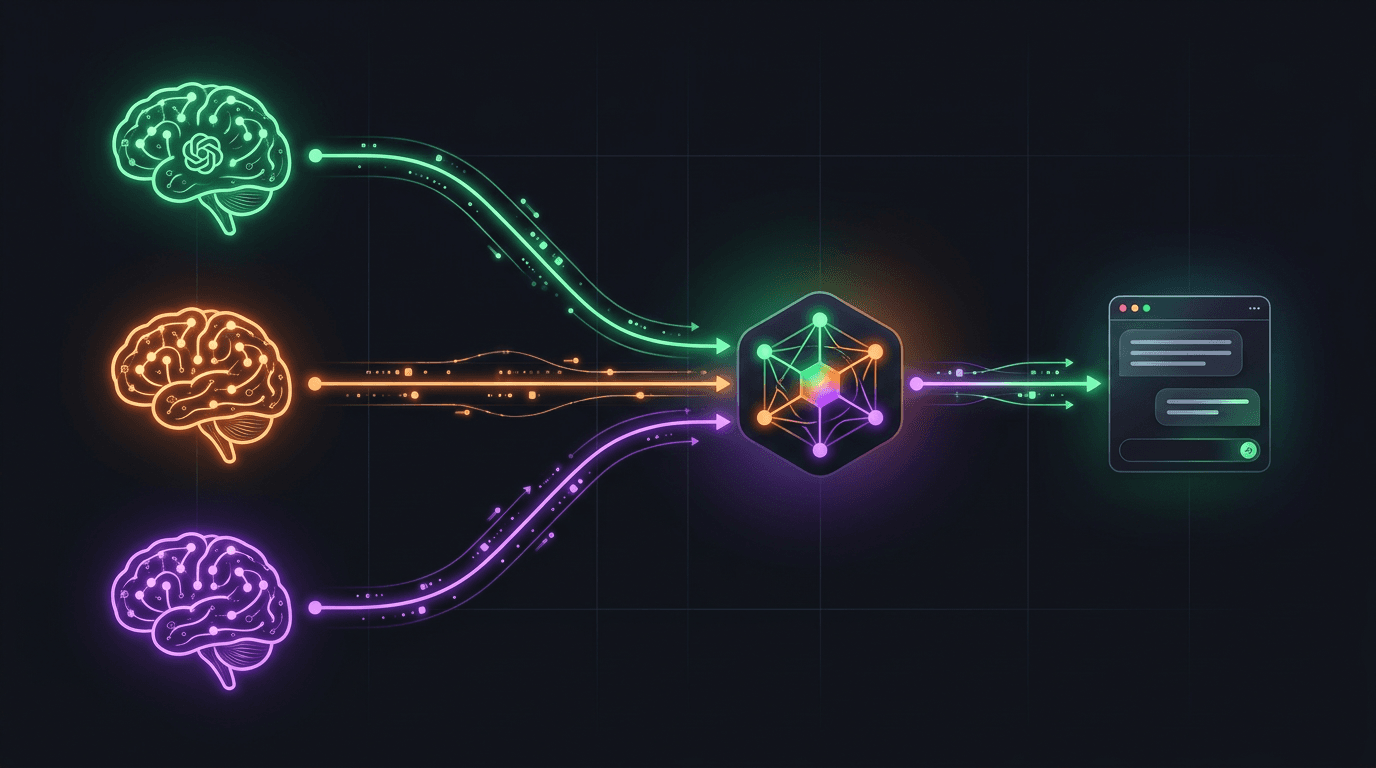
A multi-LLM strategy means configuring your chatbot to work with more than one AI provider. Instead of hardcoding OpenAI into your stack, you abstract the LLM layer so you can route requests to different providers based on rules you define.
The three pillars of a multi-LLM strategy are:
- Provider abstraction — a unified interface that works with any LLM API
- Automatic failover — if the primary provider fails, requests route to a secondary provider without manual intervention
- Per-tenant configuration — different chatbots can use different providers based on their needs, budget, or compliance requirements
How to implement provider fallback
The simplest and most effective fallback pattern follows a three-tier hierarchy:
- Primary: Cloud provider (e.g., OpenAI GPT-4o or Anthropic Claude) — best quality, highest cost
- Secondary: Alternative cloud provider (e.g., Anthropic if primary is OpenAI) — comparable quality, independent infrastructure
- Tertiary: Self-hosted model (e.g., Ollama with Llama 3) — lower cost, no external dependency, complete data control
With rentabot.chat, you configure this directly in the dashboard. Set your primary LLM, add a fallback, and optionally connect a self-hosted Ollama instance. If the primary fails, the system automatically tries the next provider in the chain — no code changes required.
Pro tip
Test your fallback chain regularly. Set up a synthetic conversation that runs every hour and verifies each provider responds correctly. You do not want to discover your fallback is misconfigured during an actual outage.
Comparing providers for chatbot use
Each provider has different strengths depending on your chatbot's use case:
| Feature | OpenAI (GPT-4o) | Anthropic (Claude) | Ollama (Llama 3) |
|---|---|---|---|
| Response quality | Excellent | Excellent | Good |
| Speed (time to first token) | ~300ms | ~400ms | ~200ms (local) |
| Cost per 1M tokens (input) | $2.50 | $3.00 | $0 (hardware costs only) |
| Data privacy | Third-party processing | Third-party processing | Fully on-premise |
| Uptime (2025 avg) | 99.4% | 99.6% | Your infrastructure |
| Context window | 128K tokens | 200K tokens | 8K-128K (model dependent) |
| Best for | General chat, function calling | Long documents, nuanced replies | Privacy-first, cost-sensitive |
When does self-hosting make sense?
Self-hosting with Ollama is not for everyone, but it makes strong sense in specific scenarios:
- GDPR or data sovereignty requirements — no chat data leaves your network
- High-volume, low-complexity conversations — FAQ-style chatbots where a smaller model handles 90% of queries
- Cost optimization at scale — once you exceed roughly 10 million tokens per month, self-hosting often becomes cheaper than API pricing
- Air-gapped environments — government, healthcare, or financial services where internet access is restricted
A good middle ground: use a cloud provider as your primary for quality, and self-hosted Ollama as your fallback for resilience. See our pricing page for how this affects costs.
FAQ
Can I switch providers without retraining my chatbot?
Yes. If your chatbot uses RAG (retrieval-augmented generation), your knowledge base is independent of the LLM provider. Switching from OpenAI to Anthropic changes only the generation step — your documents, embeddings, and conversation history stay the same.
Does switching providers affect response quality?
Slightly. Each model has its own personality and strengths. GPT-4o tends to be more concise while Claude tends to be more thorough. For most customer support scenarios, users will not notice a difference. Test your specific use case with each provider before going live.
How much does a self-hosted setup cost?
A single NVIDIA T4 GPU server (around $200-400/month from cloud providers, or a one-time $2,000-3,000 purchase) can run Llama 3 8B at production speeds. For higher quality, a 70B parameter model needs about 40GB of VRAM — roughly $800-1,200/month in cloud GPU costs.
A multi-LLM strategy is not about distrusting any single provider — it is about building resilience into your customer experience. Explore how rentabot.chat makes multi-LLM easy, or read our guide to self-hosting with Ollama.